 Remittance companies
 Crypto OTC desks
 Bitcoin ATM operators
 ATM operators
 Small businesses

On this page
The short answer to "how long does e-transfer take" is a few minutes for most payments. Interac says a transfer can take up to 30 minutes, depending on the bank or credit union. If it's been longer than that, the payment is usually waiting on a person or a fraud check.
That's true for personal and business payments. Below we explain what slows an e-Transfer down, and how Interac e-Transfer for your business works a little differently.
If you want to see how a payment moves from one bank to another, our technical guide to how Interac e-Transfer works follows one from send to deposit.
How long does an e transfer take to arrive?
Most land within minutes. Interac says that once a recipient accepts, they can typically see the funds within minutes or even seconds (Interac e-Transfer 101).
The 30-minute window exists because banks run checks on each payment. Interac says deposit times can vary because of routine fraud checks between the sending and receiving banks.
Here's a rough guide:
Autodeposit is on: usually a few minutes, up to 30.
The recipient has to accept: a few minutes after they open the notice and answer the security question.
The payment is flagged for review: longer, until the sender's bank clears it.
The recipient never accepts: it stays pending until it expires or the sender cancels it.
Why is an e-Transfer pending or held?
"Pending" means the money has left the sender's balance but hasn't been deposited yet. Interac's terms of use say the sending bank holds the funds until the transfer is deposited, cancelled or expires. There are 4 common reasons a payment sits there.
A fraud check at the sender's bank. Banks score each transfer for risk. An amount that's larger than usual, or a payment that doesn't match the sender's normal habits, can get a closer look. The bank may hold it or contact the sender to confirm it.
A first-time recipient. Some banks take extra care the first time someone sends money to a new contact. Payments can move more smoothly once there's a history between the two people.
Autodeposit is turned off. Without autodeposit, the recipient gets an email or text. They have to click it, sign in to their own bank and answer a security question. Until they do, the sender sees the payment as pending.
The recipient hasn't accepted yet. The notice may have landed in spam, or the recipient just hasn't opened it. If a transfer is never deposited, it expires and the money goes back to the sender. Each bank sets its own timing for this.
What to do when an e transfer pending status won't clear
Start with the simple checks. Most stuck payments are solved in a few minutes.
Check that the email or mobile number is correct.
Ask the recipient to look in their spam or junk folder.
If autodeposit is on and it's been over 30 minutes, contact the sender's bank. Interac says it doesn't hold funds, so the bank is the one that can trace the payment.
If needed, the sender can cancel the transfer before it's deposited. Some banks charge a fee to cancel.
Bank limits can also stop a payment before it starts. Each bank sets its own daily and per-transfer limits, and a customer who reaches theirs has to wait for it to reset. Our guide to Interac e-Transfer limits in Canada explains how they work.
How are business e-Transfers different?
Business e-Transfers run on the same network, with a few extra tools. Interac says most Interac e-Transfer for Business payments land seconds after they're sent. Businesses can also attach details like invoice numbers, which makes payments easier to match to orders.
With an Invincible Pay payment wallet, a few things work in your favour:
e-Transfer checkout: customers pay from their own bank at checkout, and the payment lands in your wallet with no holding period.
Autodeposit: incoming payments go straight in, with no security question.
Interac e-Transfer requests: you request an exact amount, and the customer approves it in their own banking app.
Bulk e-Transfer: you pay many people in one batch.
Sending: up to $25,000 per transfer, with no daily limit.
Our wallet receives without limits. Your customer is still limited by their own bank, and most people can send about $3,000 to $5,000 a day. A $250 order is easy. A large invoice may need another way to pay, such as a same-day wire.
What is Secure e-Transfer?
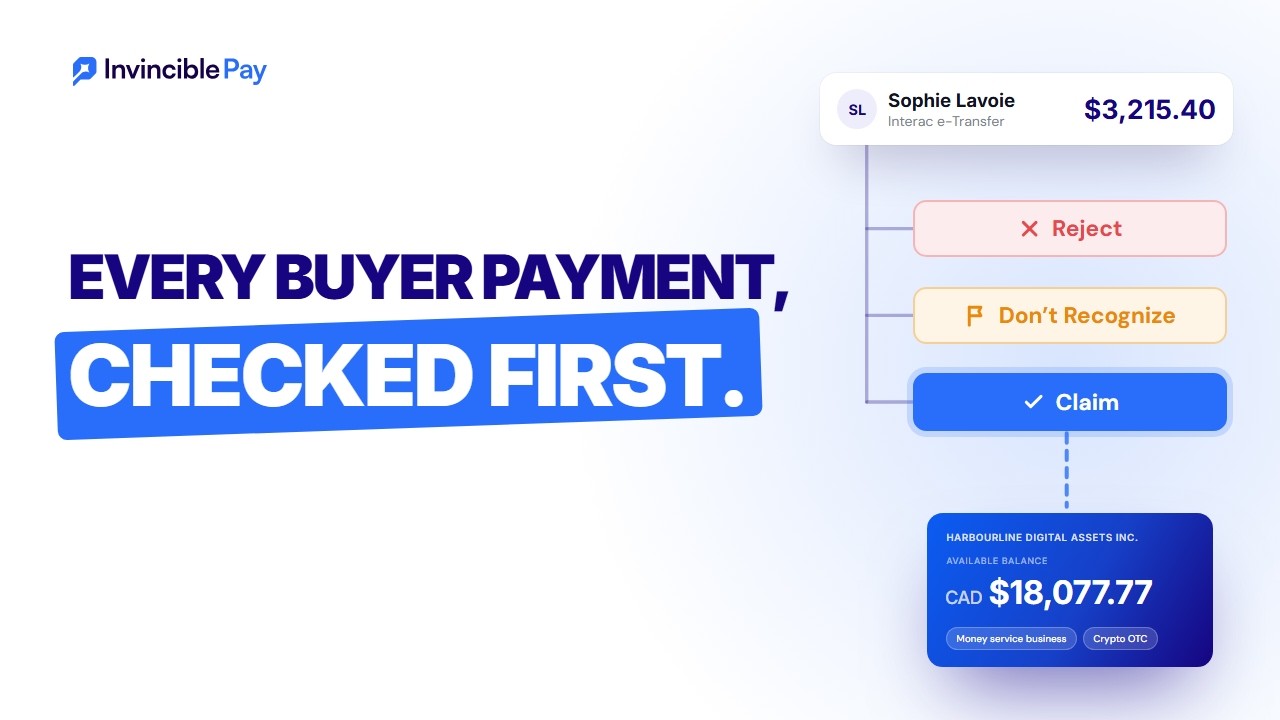
Secure e-Transfer gives a business a checkpoint before money lands. Instead of every payment going straight into your wallet, you see it first and choose what happens next.
Claim it: the payment lands in your wallet.
Reject it: the payment goes back to the sender.
Mark it as not recognised: for a payment you didn't expect, from someone you don't know.
This helps a business that gets many payments from new customers. You decide what to accept, before it's in your balance.
Will the Real-Time Rail make e-Transfers faster?
Payments Canada is building the Real-Time Rail (RTR), a new national system for real-time payments. As of October 2026, its published launch timeline is:
Q4 2026: the RTR launches with its first participants.
Q1 2027: the first Interac e-Transfer clearing and settlement participants move over.
Q2 2027: more e-Transfer participants move over.
Q3 2027: all participants in the first phases reach full transaction volumes.
The key word is settlement. That's how banks square up with each other behind the scenes. Payments Canada hasn't published any change to how fast an e-Transfer reaches the person receiving it. Most already arrive in minutes, and the fraud checks that cause holds happen at the banks.
For payments that don't need to land in minutes, like payroll, EFT is the other main option. It typically takes 1 business day.
Want e-Transfer checkout, requests and Secure e-Transfer in one payment wallet? Tell us about your business. We reply within 24 hours on business days.
Frequently asked questions
Why is my e transfer pending?
The recipient most likely hasn't deposited it yet. Without autodeposit, they need to open the notice and answer the security question. It can also be held for a fraud check at the sender's bank. If it's still pending after 30 minutes and autodeposit is on, contact the sending bank.
Can I cancel an e-Transfer that's pending?
Usually yes, as long as it hasn't been deposited. Interac's terms say the sender may cancel before the money is deposited. Some banks charge a cancellation fee. Once a transfer is deposited, it can't be reversed.
Is an e-Transfer faster than EFT?
Yes. An e-Transfer usually arrives in a few minutes, up to 30. EFT, also called direct deposit, typically takes 1 business day. EFT works well for payroll, while e-Transfer suits payments you want to see land the same day.
How much does it cost to receive e-Transfers as a business?
With Invincible Pay, it's $1.95 + 0.20% per transaction. Money services, crypto, high-risk and iGaming businesses also pay a $500 one-time setup fee. They also have a $500 monthly minimum that counts toward transaction fees. From November 1 to January 7, money services and high-risk businesses onboarded by January 7 get both waived. See our pricing.
How fast can my business start taking e-Transfers?
You can apply in about 20 minutes. Once we have your documents, we usually approve within 3 business days. You're usually processing payments within 5.