 Remittance companies
 Crypto OTC desks
 Bitcoin ATM operators
 ATM operators
 Small businesses
On this page
- Why Does Payment Processing Matter So Much for Digital Products?
- What Payment Methods Should Canadian Course Creators Accept?
- How Do You Choose the Right Payment Platform?
- How Should You Price Your Digital Products in Canada?
- How Do You Handle Refunds and Chargebacks on Digital Products?
- How Do Subscription Models Work for Canadian Digital Product Businesses?
- What Canadian Regulations Apply to Selling Digital Products?
- How Do You Set Up Your Payment Stack Step by Step?
- What Are the Most Common Mistakes to Avoid?
- Frequently Asked Questions
Canadian course creators and digital product sellers need a payment setup that keeps fees low, handles refunds cleanly, and gets money into their account fast. The best approach combines Interac e-Transfer checkout (which costs a fraction of credit card processing) with flexible options like payment links and direct deposits, all run through a single regulated platform that supports subscriptions, one-time purchases, and high-volume sales.
Whether you sell a $29 PDF template or a $2,000 coaching program, the way you collect money directly affects your margins, your customer experience, and your ability to scale. This guide breaks down everything Canadian digital product sellers need to know about choosing, setting up, and optimizing their payment stack in 2026.
Why Does Payment Processing Matter So Much for Digital Products?
Selling digital products is fundamentally different from selling physical goods. There is no shipping cost, no warehouse, and no inventory to manage. Your margins should be excellent. But if your payment processor is eating 2.5% to 3.5% of every transaction, those margins shrink fast.
Consider the math. A course creator doing $10,000 per month in sales through a standard credit card processor at 2.9% plus $0.30 per transaction pays roughly $320 in processing fees every month. That is $3,840 per year just in payment processing. For a solo creator or small team, that is a meaningful chunk of revenue that could go toward marketing, content creation, or simply staying profitable.
Digital products also come with unique payment challenges that physical product sellers rarely face:
Chargebacks are more common because delivery is harder to prove. A customer can claim they never received a download even when your server logs show they accessed it three times. Subscription billing creates recurring touchpoints where customers forget they signed up, see the charge, and dispute it. And refund expectations vary wildly because there is no physical item to "return."
The Canadian online learning market alone was projected to generate roughly $9.48 billion CAD in revenue in 2025, with annual growth rates above 9%. Independent course creators, coaches, and digital product sellers make up a growing share of that number. Getting payment processing right is not a minor operational detail. It is a core business decision.
What Payment Methods Should Canadian Course Creators Accept?
The short answer: as many as your customers expect, while keeping your costs low. Here is what works best for the Canadian market.
Is Interac e-Transfer the Best Option for Digital Sales?
For Canadian sellers, Interac e-Transfer is the standout choice. Nearly every Canadian with a bank account can send one, and the fees are dramatically lower than credit card processing. While credit card transactions typically cost merchants 2.5% to 3.5% per sale, Interac e-Transfer costs a fraction of that amount.
The challenge has always been that e-Transfer felt manual. A customer would buy your course, then you would need to check your inbox for the payment notification, manually confirm receipt, and then grant access. That workflow does not scale.
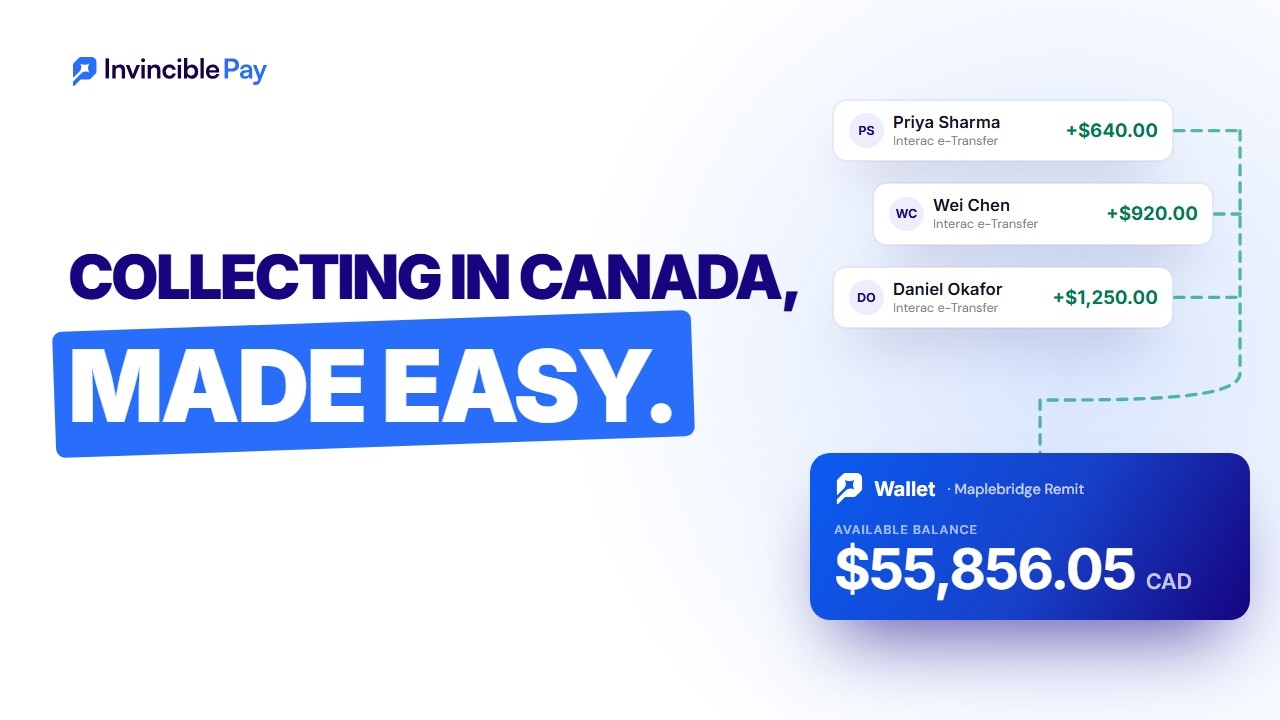
This is where e-Transfer checkout changes the game. Platforms like Invincible Pay offer e-Transfer checkout as a payment method at the point of sale. The customer selects Interac e-Transfer at checkout, completes the payment through their banking app, and the funds arrive in the seller's wallet within minutes. No manual matching. No waiting for batch settlements. The experience feels just as smooth as paying by credit card, but the processing cost is significantly lower.
For a creator doing $10,000 per month in sales, switching even half of those transactions from credit card to e-Transfer checkout could save $1,500 or more per year.
Should You Still Accept Credit Cards?
Yes, but strategically. Some customers prefer credit cards for the points, the purchase protection, or simply because they are used to it. Refusing credit cards means losing some sales. The smart approach is to offer both options and gently encourage e-Transfer by making it the default or most prominent option at checkout.
Credit card processing in Canada typically costs between 1.4% and 3.5% depending on the card type, the processor, and whether the transaction is online (card not present) or in person. Online transactions, which is what digital product sellers deal with, tend to sit at the higher end of that range. Square, for example, charges 2.8% plus $0.30 for online credit card transactions in Canada.
American Express cards cost even more. While Amex has narrowed the gap in recent years, their fees still tend to run higher than Visa and Mastercard for most merchants.
What About PayPal and Other Digital Wallets?
PayPal remains popular for international buyers and customers who do not want to enter their credit card details on an unfamiliar site. The trade-off is fees. PayPal's standard rate for online transactions in Canada is 2.9% plus a fixed fee, which is comparable to credit card processing and significantly more expensive than e-Transfer.
If you sell primarily to Canadian customers, PayPal should be an option but not your primary payment rail. For international sales, it can be worth the cost because it removes friction for buyers in other countries.
How Do You Choose the Right Payment Platform?
Not all payment platforms are built for digital product sellers. Here is what to look for.
What Features Matter Most for Course Creators?
The ideal platform for a Canadian digital product business should offer several key capabilities. First, it should support multiple payment methods in a single dashboard. Juggling separate accounts for e-Transfer, credit cards, and direct deposits creates reconciliation headaches and makes tax time painful.
Second, look for instant or near-instant settlement. Traditional credit card processors hold your funds for one to three business days before releasing them. That delay matters when you need to reinvest in advertising or pay contractors. Invincible Pay, for example, settles e-Transfer payments into your wallet within minutes rather than making you wait for a batch settlement cycle.
Third, consider whether the platform supports payment links. Payment links are shareable URLs that take a customer directly to a checkout page. They are perfect for selling courses through email campaigns, social media posts, or direct messages. You do not need a full e-commerce website to use them. Just generate a link, share it, and collect payment.
Fourth, look for API access if you plan to scale. An API lets you integrate payment processing directly into your course platform, membership site, or custom application. This matters when you outgrow manual processes and need automated enrollment, access control, and billing.
Should You Use a Course Platform or a Standalone Payment Processor?
This is one of the biggest decisions digital product sellers face. Platforms like Teachable, Thinkific, and Kajabi bundle course hosting with built-in payment processing. The convenience is real, but it comes at a cost.
Most course platforms charge a monthly subscription (often $39 to $199 per month) plus a transaction fee on every sale. Some also restrict which payment methods you can offer. If the platform only supports Stripe or PayPal, your Canadian customers cannot pay via e-Transfer at checkout, and you are stuck with credit card fees on every transaction.
The alternative is to host your course content on a simpler platform (or even your own website) and use a standalone payment processor that gives you more control. With a platform like Invincible Pay, you can accept e-Transfer payments at checkout, send payment links, process direct deposits, and manage everything from a single wallet. The funds hit your account faster, the fees are lower, and you are not locked into a single ecosystem.
The right choice depends on your volume and technical comfort. If you are just starting out and want the simplest possible setup, an all-in-one course platform makes sense. If you are doing consistent monthly revenue and want to keep more of it, separating your course hosting from your payment processing is usually the better financial decision.
How Should You Price Your Digital Products in Canada?
Pricing strategy and payment processing are more connected than most creators realize. The payment method your customers use, the fees you pay, and the refund policies you set all affect what price points make sense.
What Price Points Work Best for Different Product Types?
Digital products in Canada generally fall into a few categories, each with its own pricing sweet spot.
Low-cost digital downloads like templates, checklists, and short ebooks typically sell for $9 to $49 CAD. At these price points, every percentage of processing fees matters because the absolute fee per transaction is small. A $0.30 fixed fee on a $9 sale is already 3.3% before the percentage-based fee even kicks in. For low-ticket items, e-Transfer checkout or payment links with minimal per-transaction fees make the biggest difference.
Mid-range courses and workshops usually land between $97 and $497 CAD. This is the bread and butter for most independent course creators. At these price points, the percentage-based fee is the bigger concern. Saving 1.5% to 2% on processing by using e-Transfer instead of credit cards adds up to real money over hundreds of transactions.
Premium programs, group coaching, and certification courses range from $500 to $5,000 CAD or more. At these levels, customers often prefer to pay in installments. Your payment platform needs to handle recurring billing reliably, and you need a processor that can handle large individual transactions without triggering fraud alerts or hitting transaction limits. Invincible Pay supports e-Transfer transactions up to $25,000, which means even high-ticket sales can go through in a single payment without splitting.
Should You Offer Payment Plans?
Payment plans increase conversion rates for products priced above $200 to $300. A $997 course with a three-payment option of $349 per month will typically outsell the same course offered only at the full price. The trade-off is that some customers will default on later payments, and you need a billing system that handles the recurring charges automatically.
When offering payment plans, make sure your payment processor supports automated recurring billing. Manually chasing customers for their second or third installment is not sustainable. You also need clear terms about what happens if a payment fails, including whether access to the course content is paused or revoked.
How Do You Handle Refunds and Chargebacks on Digital Products?
Refunds and chargebacks are the hidden cost center that catches many digital product sellers off guard.
Why Are Chargebacks So Common with Digital Products?
Digital goods are considered higher risk by payment processors for a few reasons. There is no physical delivery to prove the product was received. Customers sometimes experience buyer's remorse and dispute the charge instead of requesting a refund through proper channels. And subscription billing, which is common for membership sites and ongoing course access, creates recurring charges that customers sometimes forget about and then dispute.
Research shows that nearly 60% of cardholders file a chargeback without ever contacting the merchant first. They go straight to their bank instead of asking for a refund. Each chargeback costs the merchant not only the original transaction amount but also a chargeback fee, which typically ranges from $15 to $50 CAD depending on the processor. Rack up too many chargebacks and your processor may freeze your account or terminate your merchant agreement entirely.
What Refund Policy Should You Use?
The best refund policy for digital products balances customer confidence with business protection. A no-refund policy might seem safe, but it actually increases chargebacks because customers who feel stuck will go to their bank instead. A clear, reasonable refund window (7 to 30 days is standard for courses) actually reduces disputes because it gives customers a legitimate path to get their money back.
Your refund policy should clearly state the refund window, what happens to course access after a refund is processed, and how customers should request a refund (make it easy and obvious). Requiring customers to email a specific address with their order number is usually enough. The easier you make the refund process, the less likely customers are to skip it and file a chargeback instead.
How Does e-Transfer Reduce Chargeback Risk?
One underappreciated advantage of accepting payments via Interac e-Transfer is that e-Transfers are not subject to the same chargeback process as credit card transactions. Once an e-Transfer is deposited, it generally cannot be reversed by the sender's bank. This does not mean you should refuse legitimate refund requests (your reputation depends on fair treatment), but it does mean you are not exposed to the same risk of fraudulent chargebacks that credit card payments carry.
For digital product sellers who have experienced chargeback issues, shifting a larger portion of transactions to e-Transfer checkout can meaningfully reduce that exposure while still providing a smooth customer experience.
How Do Subscription Models Work for Canadian Digital Product Businesses?
Subscriptions and memberships are the most reliable revenue model for digital product sellers. Instead of relying on one-time launches and hoping each new product sells, a subscription generates predictable monthly or annual revenue.
What Types of Subscription Models Work for Digital Products?
The most common models for Canadian creators include monthly membership sites (typically $19 to $97 CAD per month) that grant access to a library of content, community features, or ongoing coaching. Annual subscriptions at a discounted rate (often equivalent to 10 months of the monthly price) encourage longer commitment and reduce churn.
Cohort-based programs are another growing model. These are time-limited group experiences (usually 4 to 12 weeks) with a defined start and end date. Completion rates for cohort-based courses run as high as 85% to 90%, compared to roughly 5% to 15% for self-paced courses. Higher completion rates mean happier customers, fewer refund requests, and stronger word-of-mouth referrals.
What Payment Infrastructure Do Subscriptions Require?
Running subscriptions requires a payment platform that can handle automated recurring billing, failed payment retries, and easy cancellation. The platform also needs to communicate billing events clearly to customers. Sending a reminder before each billing date reduces surprise charges and the disputes that follow.
Look for a processor that lets you manage all subscription revenue from one dashboard alongside your one-time sales. Juggling separate tools for subscription billing and one-off product sales creates unnecessary complexity and makes it harder to understand your true revenue picture.
What Canadian Regulations Apply to Selling Digital Products?
Selling digital products in Canada involves a few regulatory considerations that sellers often overlook.
Do You Need to Charge GST/HST on Digital Products?
Yes. Digital products and services sold to Canadian customers are generally subject to GST/HST. If your annual revenue exceeds $30,000, you are required to register for a GST/HST number and collect the appropriate tax on sales to Canadian buyers. The rate depends on the customer's province, ranging from 5% (GST only in Alberta) to 15% (HST in provinces like Nova Scotia and New Brunswick).
Non-resident digital sellers who sell to Canadian consumers may also be required to register and collect GST/HST under rules that came into effect in 2021.
What About Privacy and Data Protection?
If you collect personal information from customers (which you do whenever you process a payment or create a user account), you are subject to Canada's Personal Information Protection and Electronic Documents Act (PIPEDA) at the federal level, plus provincial privacy legislation in Alberta, British Columbia, and Quebec. Your payment processor should be compliant with these requirements, and you should have a clear privacy policy on your website.
Using a FINTRAC-registered, Bank of Canada-regulated payment provider like Invincible Pay means the payment side of your operation is already operating within Canada's regulatory framework. That matters both for your own compliance and for the trust it builds with customers who see that their money is being handled by a regulated entity with funds insured and safeguarded per RPAA standards.
How Do You Set Up Your Payment Stack Step by Step?
Here is a practical walkthrough for getting your payment infrastructure up and running.
What Is the Simplest Setup for a New Creator?
If you are launching your first digital product and want to start accepting payments today, here is the fastest path:
Open a business wallet with a payment provider that supports e-Transfer checkout and payment links. With a platform like Invincible Pay, onboarding takes about five minutes and most accounts are approved within 24 to 48 hours.
Once approved, generate a payment link for your product. Share that link on your website, in your email list, or on social media. Customers click the link, choose their payment method (e-Transfer or card), complete the purchase, and the funds land in your wallet. You can set up automated delivery of your digital product using email or your course platform's enrollment system.
This setup requires zero coding, no monthly platform fees, and no complex integrations. It is ideal for validating a product idea before investing in a full tech stack.
What Does a Scaled Setup Look Like?
As your business grows beyond a few hundred dollars per month, you will want a more automated setup. This typically involves integrating your payment processor's API with your course platform or website. API integration lets you automate enrollment (granting course access immediately after payment), handle subscription billing programmatically, and sync transaction data with your accounting software.
At this stage, you should also be using batch processing for any recurring payouts you make (paying contractors, affiliate commissions, or collaborators). Direct deposit capabilities let you pay multiple people from a single upload rather than sending individual e-Transfers one at a time.
What Are the Most Common Mistakes to Avoid?
Relying on a Single Payment Method
Offering only credit card payments leaves money on the table and keeps your fees unnecessarily high. Offering only e-Transfer may alienate customers who prefer the convenience and purchase protection of credit cards. The winning strategy is to offer both and optimize for the lower-cost option.
Ignoring Failed Payments on Subscriptions
Failed payment recovery is one of the most overlooked revenue opportunities for subscription businesses. Credit cards expire, bank accounts change, and payments get declined. Without an automated retry process and clear communication to customers about updating their payment method, you will lose subscribers who actually want to keep paying.
Not Tracking Your Effective Processing Rate
Your effective processing rate is the total processing fees you pay divided by your total revenue. Most creators have no idea what this number is. Calculate it monthly and look for opportunities to bring it down by encouraging more e-Transfer payments or negotiating better rates as your volume grows.
Overcomplicating the Checkout Experience
Every additional step in your checkout flow costs you conversions. A customer who has to create an account, verify their email, choose a payment method, and then complete a multi-step form is far more likely to abandon the purchase than one who clicks a payment link and pays in two taps. Keep it simple.
Frequently Asked Questions
Can I accept Interac e-Transfer as a checkout payment method for my online course?
Yes. E-Transfer checkout lets your customers pay via Interac directly at the point of sale, just like they would with a credit card. Platforms like Invincible Pay offer this as a built-in checkout option. The customer selects e-Transfer, completes the payment in their banking app, and the funds arrive in your business wallet within minutes.
How much can I save by switching from credit card processing to e-Transfer checkout?
The savings depend on your volume, but the difference is significant. Credit card processing for online transactions in Canada typically costs 2.5% to 3.5% per sale. E-Transfer checkout costs a fraction of that. On $10,000 in monthly sales, switching from credit cards to e-Transfer checkout could save $200 to $300 per month or more, depending on your current processor's rates.
Do I need a GST/HST number to sell digital products in Canada?
If your total taxable revenue exceeds $30,000 over four consecutive calendar quarters (or in a single quarter), you must register for a GST/HST number. Below that threshold, registration is optional but may be worthwhile if you want to claim input tax credits on your business expenses.
What happens if a customer files a chargeback on a digital product purchase?
With credit card payments, chargebacks can be filed by the customer's bank, and the funds are withdrawn from your account while the dispute is investigated. You will also pay a chargeback fee regardless of the outcome. E-Transfer payments are generally not subject to the same chargeback process, which is one reason many digital product sellers prefer them. Regardless of payment method, having a clear refund policy and accessible customer support reduces chargeback risk significantly.
How do I handle international customers who cannot use Interac e-Transfer?
For international buyers, accept credit cards or PayPal as alternative payment methods. Interac e-Transfer is a Canadian payment rail, so it is only available to people with Canadian bank accounts. A dual approach (e-Transfer for Canadian customers, credit card or PayPal for international ones) covers both audiences while keeping your domestic transaction costs low.
Ready to keep more of every sale? Open your Invincible Wallet in minutes and start accepting e-Transfer payments at checkout. Lower fees, instant settlement, and one dashboard for everything. Get started with Invincible Pay today.